Learning Comparison
Rankaris vs. Coursera: Which GEO Learning Approach Fits Your Workflow?
The clean answer is simple.
Choose Coursera if you want a GEO course you can start now, follow in order, and finish with a certificate. Choose Rankaris if you already know the basic language of GEO but still struggle with the harder question: what should I actually do next?
They overlap, but they are not trying to solve the same learning problem.
Coursera gives you a curriculum. Rankaris trains judgment. For a lot of founders, those two things belong together. But if your time is limited, start with the gap that is slowing you down today.
The real difference is the decision you need help making
Coursera is a broad online learning platform. Universities, companies, and training providers publish courses, Specializations, Professional Certificates, and degrees there. Its GEO catalog currently includes a Generative Engine Optimization Specialization comprising three courses, an AI SEO: Mastering Generative Engine Optimization course that takes about four hours, and an AI SEO and GEO Professional Certificate.
That is useful when you need someone to organize the field for you. You get a syllabus, a sequence, assignments, and a visible finish line.
Rankaris is much narrower. It is a game based GEO learning product for founders, independent developers, and website operators. The Rankaris Product Guide describes a loop built around a principle, a decision, a realistic scenario, and a feedback window. The learner has to make a call, see where the reasoning holds up, and decide what signal would justify the next move.
I built Rankaris around a pattern I kept seeing: people were collecting GEO tactics faster than they could judge them. They knew they could publish another comparison page, add schema, improve citations, or fix a technical issue. What they did not know was which action deserved this week's time.
That gap matters more than it sounds. A founder can understand ten good tactics and still waste a month doing the ninth most important one.
| If you need help with... | Better starting point | Why |
|---|---|---|
| Learning GEO vocabulary and methods in a clear order | Coursera | The course structure removes the need to build your own syllabus |
| Earning a documented completion credential | Coursera | Eligible programs provide shareable certificates |
| Connecting GEO with SEO, analytics, content, or generative AI | Coursera | The wider catalog gives you more adjacent learning paths |
| Choosing between several plausible GEO actions | Rankaris | The practice is built around prioritization and tradeoffs |
| Explaining what evidence would justify an action | Rankaris | Scenarios connect the choice to a signal and feedback window |
| Building a foundation, then testing your judgment | Both | The course builds the map; decision practice tests how you use it |
What learning on Coursera actually looks like
A Coursera workflow starts with course selection. You compare the provider, syllabus, level, duration, ratings, projects, and credential. Then you work through whatever mix of videos, readings, quizzes, assignments, labs, and projects that provider has designed.
For example, the SkillUp AI SEO and GEO course lists two modules, quizzes, a content mapping lab, a GEO metrics exercise, and a content rewrite lab. The Edureka GEO Specialization lists three courses, practical projects, a flexible schedule, and a shareable certificate.
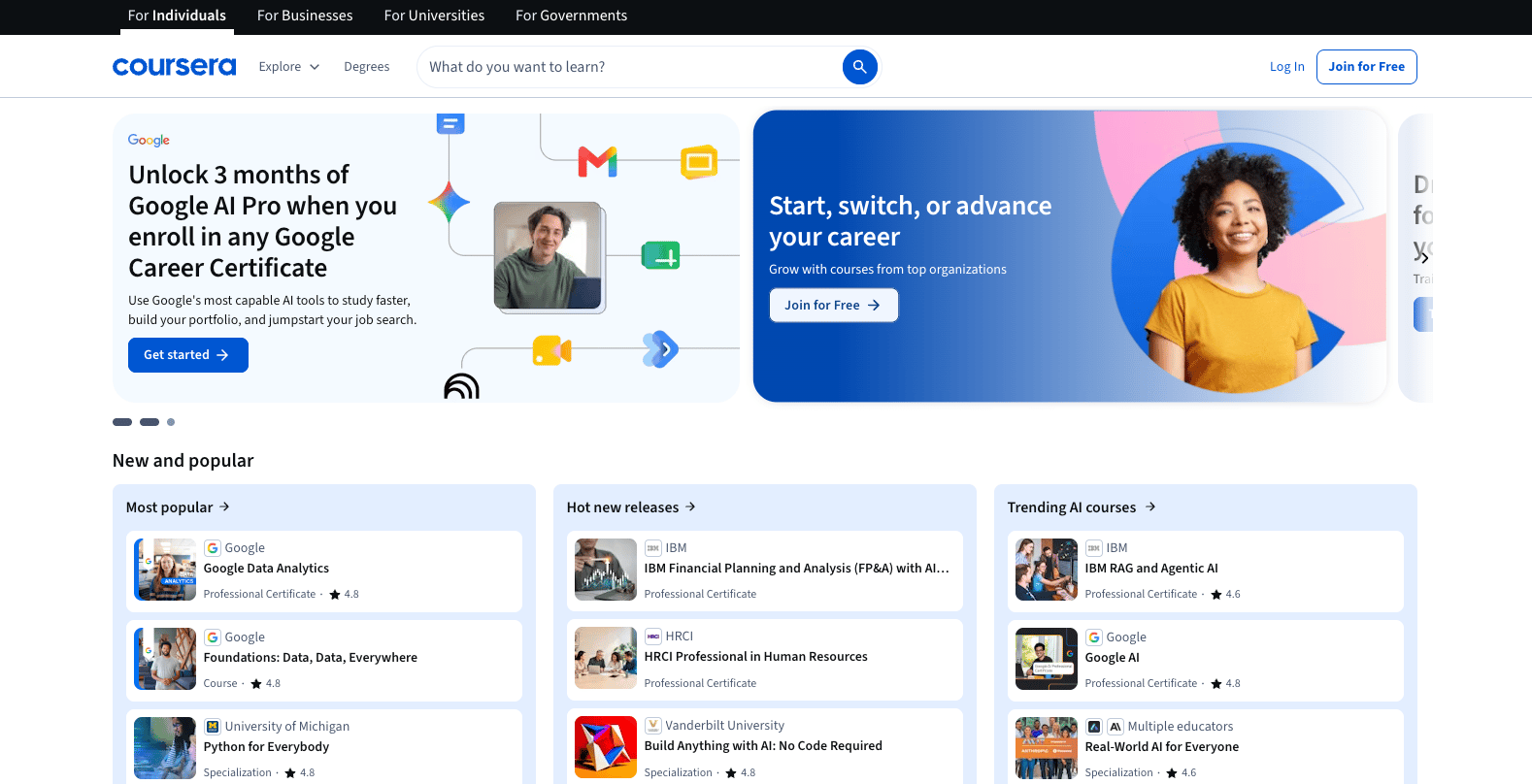
The important detail is easy to miss: Coursera is the platform, not one single GEO curriculum. Its documentation for industry partners says that most partners develop and maintain their own Professional Certificate content, while Coursera offers optional support with curriculum, production, and maintenance.
So “it is on Coursera” is not enough information to make a good choice. Two courses can use GEO in the title and still differ sharply in audience, depth, assessment style, and how recently the material was updated. You have to inspect the individual course.
I would check five things before enrolling:
- Who created the course, and what have they actually done in search or AI visibility?
- Does the syllabus teach concepts only, or does it require work on a real page or site?
- Are the examples current enough for a field that changes quickly?
- Do the assignments produce something you can inspect, such as a rewritten page, prompt set, measurement record, or implementation plan?
- Is the certificate useful for your goal, or are you mainly paying for structure?
Coursera's learner help center documents quizzes, assignments, peer review, grades, programming work, and labs. Those mechanics can be valuable. They create momentum and make progress visible. They do not tell you whether a particular GEO course is deep, current, or right for your site.
What Rankaris is trying to train
Rankaris starts later in the process. It assumes the learner can recognize a GEO tactic and needs practice deciding whether that tactic matters now.
A scenario might force a website operator to choose between publishing another content asset, strengthening the evidence on an existing page, fixing a technical prerequisite, or waiting long enough for a previous change to produce a useful signal. The point is not to guess the answer the product wants. The point is to connect the decision to the site's constraint, the available evidence, and the time window in which anything meaningful could change.
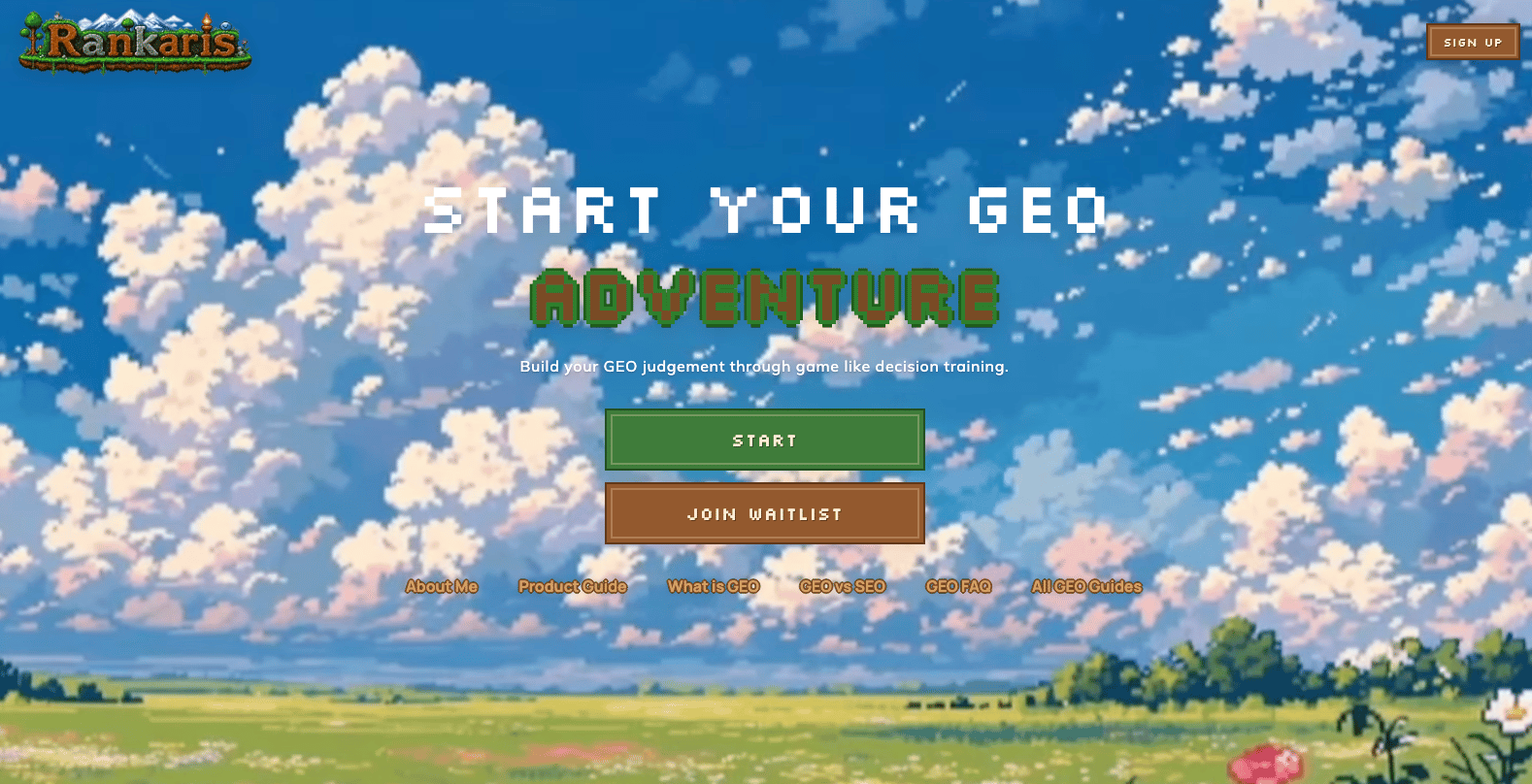
This is the part that ordinary educational content often skips. A lesson can explain why original evidence helps a page become more citable. Real work begins when you have to decide whether to gather that evidence now, fix distribution first, or leave the page alone because a more basic problem is blocking discovery.
The Rankaris About page and Product Guide explain why the product uses repeated decisions rather than a large course library. The intended output is a better reason for doing something now, later, or not at all.
There is also an honest limitation. Rankaris is in waitlist and early access. Its public material explains the product direction and learning loop, but it does not yet verify a mature module catalog, a formal credential, integrations, or learner outcome data. If you need an available course this week, Coursera is easier to evaluate. There is no clever way around that.
A certificate and better judgment are different outcomes
A course gives you a clean kind of progress. You finish modules, pass assessments, complete projects, and perhaps earn a shareable certificate. That can be useful for a job search, a team development plan, or simply keeping yourself accountable.
Founders often have a different problem. They can watch the lesson and agree with every point, then open their backlog and still have no idea what to do on Monday.
That is why I would choose based on the bottleneck:
- If the field still feels confusing, get the structured foundation.
- If you understand the concepts but keep changing priorities, train the decisions.
- If you need both, take one focused course, apply its exercises to a real site, and then challenge the order of the work.
The third path is probably the strongest for a new operator. But “both” should not become an excuse to consume twice as much material. One course is enough to reveal whether your real gap is knowledge or execution judgment.
Be careful with outcome claims from either side
Neither product implements GEO for you. A certificate does not prove that a site became more visible in AI answers. A strong scenario answer does not create citations, recommendations, branded searches, referrals, signups, or revenue.
The wider GEO evidence base is still unsettled. A July 2026 critical survey of 45 GEO studies found inconsistent terminology, metrics, and evidence standards. The reviewed literature had not established a stable, longitudinal effect across platforms on organic discoverability or downstream behavior.
That does not make GEO training useless. It changes what a responsible learning product should promise. You should expect a course or practice system to improve your understanding, your work, or the quality of your decisions. You should be skeptical when it jumps from a classroom exercise or a short visibility observation to a guaranteed business result.
This comparison uses Coursera's public course pages and platform documentation, the supplied screenshot, and Rankaris's public product material. I also found no independent outcome study for the Coursera GEO offerings cited here. Course ratings can help with selection, but they are not proof that the course improved AI visibility.
Which one fits your workflow?
Choose Coursera when you want an available, ordered path through GEO. It is the practical choice if you prefer lessons and assignments, want a credential, or need to connect GEO with a broader marketing skill set. Just evaluate the provider and syllabus, because the Coursera name does not make every GEO course equivalent.
Choose Rankaris when the vocabulary is no longer the problem. It is designed for operators who keep facing the same uncomfortable decision: several tactics look reasonable, the team is small, and only one or two can happen now. Early access means you are evaluating a product direction, not buying a mature credential program.
If I were starting from scratch, I would pick one Coursera course that matches the work I actually do, apply every useful exercise to a live site, and keep a record of the decisions that still felt unclear. That record tells you whether you need more lessons or judgment practice.
Learning more GEO is easy to justify. Choosing the next piece of work is where the cost shows up.

About SeanG
- Founder of Rankaris
- Former systems designer focused on AI search for over 2 years
- Independent developer writing about GEO and AI visibility
Identity: X · LinkedIn · gsc578045031@gmail.com