
Editorial Workflow
Evidence Packs vs Prompt First Writing: Which Workflow Creates Better Content?
After reviewing many GEO articles, I noticed the weakest ones usually do not fail at writing, they fail before writing starts.
Why the workflow matters
Most AI writing workflows sell the same easy story: write a better prompt, get a better article.
That is partly true. It's also where a lot of bad GEO content starts.
A good prompt can improve the shape of a draft. It can make the writing cleaner, faster, and less painful to edit. But it cannot decide which claims are true, which examples matter, which sources deserve weight, or whether the article should exist in the first place. That work has to happen before the draft.
That is the difference between prompt first writing and evidence pack first writing. Prompt first writing starts with the model. Evidence pack first writing starts with the material the model is allowed to use.
For low risk drafts, the first approach is fine. For GEO content, SEO content, and pages that you want humans or answer engines to trust, it is usually the weaker workflow.
The Short Answer
Evidence packs create better content when the page needs to be trusted, cited, or used for a real decision. Prompt first writing is useful for expression. It is not a substitute for evidence selection.
The better workflow is:
research -> evidence -> brief -> content -> audit -> rewrite -> measurement
That sequence looks slower. In practice, it often saves time because the draft has fewer problems to rescue later. The hard part of content is not producing paragraphs anymore. The hard part is deciding what the paragraphs are allowed to claim.
Where Prompt First Writing Breaks
Prompt first workflows tend to fail in predictable ways:
- They choose the thesis before the evidence is clear.
- They backfill sources after the argument already sounds finished.
- They make weak claims and strong claims sound equally confident.
- They reward generic completeness because the draft has to cover the topic.
- They turn editing into polish instead of judgment.
That last one is the real problem. A team edits the sentence, not the claim. They improve the introduction, not the source base. They add a table, but the table only organizes common sense. The article becomes more presentable without becoming more useful.
For GEO, that is not a small issue. AI search systems and answer engines do not need another page that repeats a basic definition. They need material that is clear enough to extract, specific enough to distinguish, and grounded enough to trust.
A prompt first article about AI visibility might say, "Track your AI visibility score regularly." That sounds practical. It is also thin. What does the score measure? Which prompts created it? Was the test logged in or logged out? What location was used? Did the answer cite you, mention you, recommend you, or just include your name near a competitor? Did anything downstream move, such as branded search, referral traffic, signups, demos, or sales conversations?
Those questions are where the real article begins. A prompt will not reliably ask them unless someone has already done the thinking.
What an Evidence Pack Actually Does
An evidence pack is the working record behind the article. It is not a mood board. It is not a folder of random links. It is the set of claims, sources, examples, questions, constraints, and decisions that shape the draft before writing starts.
For a GEO article, I would expect an evidence pack to include things like:
- the exact reader question the page is answering
- the core claims the article is allowed to make
- source notes with the date checked and the reason each source matters
- product facts or internal observations that cannot be invented by a model
- customer questions, sales objections, or support patterns
- competitor pages worth comparing against
- claims that need careful wording because the signal is noisy
- examples that show how the idea works in practice
- audit criteria for deciding whether the draft is ready
That sounds basic. It is also the part most teams skip.
The evidence pack changes the role of AI. The model is no longer being asked to create authority out of a keyword. It is being asked to organize and explain selected material. That is a much better use of AI because the source of truth sits outside the model.
The Workflow That Usually Wins
The workflow I trust is simple:
| Stage | What You Decide | What Should Exist |
|---|---|---|
| Research | What do we know, and what are we guessing? | Raw notes, sources, customer questions, SERP context |
| Evidence | Which claims are strong enough to use? | Evidence pack with claims, support, examples, limits |
| Brief | What should this page help the reader understand or decide? | Angle, audience, structure, boundaries |
| Content | How do we turn the brief into a clear draft? | Article draft, AI assisted if useful |
| Audit | Where is the draft vague, unsupported, or hard to cite? | Specific revision notes |
| Rewrite | What needs to be cut, sharpened, sourced, or reframed? | Stronger version of the article |
| Measurement | Did the asset create useful visibility or downstream signal? | Learnings for the next cycle |
The table is not the magic. The discipline is.
Each stage forces a different question. Research asks what is true. Evidence asks what is usable. The brief asks what the reader needs. The draft asks for expression. The audit asks whether the page can survive inspection. Measurement asks whether the work mattered outside the document.
Prompt first writing collapses too many of those steps into one moment. That is why it feels fast, but is also why the output often needs heavy repair.
A Small Example
Say you are writing a page about "AI visibility tracking."
A prompt first workflow might start with:
Write a comprehensive article about AI visibility tracking for B2B SaaS teams. Explain why it matters, how to measure it, and best practices.
You will get something readable. You will also probably get familiar advice: track mentions, monitor citations, compare competitors, update content, review regularly.
None of that is wrong. It is just not enough.
An evidence pack first workflow would collect the messy details first:
- Which engines were tested?
- Which prompts were used?
- Were prompts buyer intent, informational, branded, or competitor comparison prompts?
- Was the answer saved with the date, location, logged in state, and raw output?
- Did the system cite the brand, mention it without citation, or recommend it as a vendor?
- Which competitors appeared in the same answer?
- Did visibility changes connect to any downstream signal?
- Which claims about "AI visibility" are still too unstable to state with confidence?
Now the article has something to say. It can explain that a mention is not the same as a recommendation. It can show why raw answer exports matter. It can warn that a single score may hide prompt volatility. It can give the reader a way to record evidence before turning it into a dashboard.
That is better content because it changes how someone works tomorrow.
A Failure Example
The failure case is easy to miss because it looks productive at first. A site publishes a large batch of AI generated or programmatic pages. Google discovers many of them. Some get indexed. The dashboard looks like progress. The team thinks the machine is working.
Then the quality system catches up.
There is a Google Search Console case: it shows roughly 9.3K indexed pages and 895 not indexed pages, with a visible not indexed movement around early March 2026. What does this tell us?
It does not prove the cause by itself, but it shows the risk clearly: large batches of thin or weakly differentiated pages can look fine in Search Console for a while, then lose index coverage when quality systems reassess them.
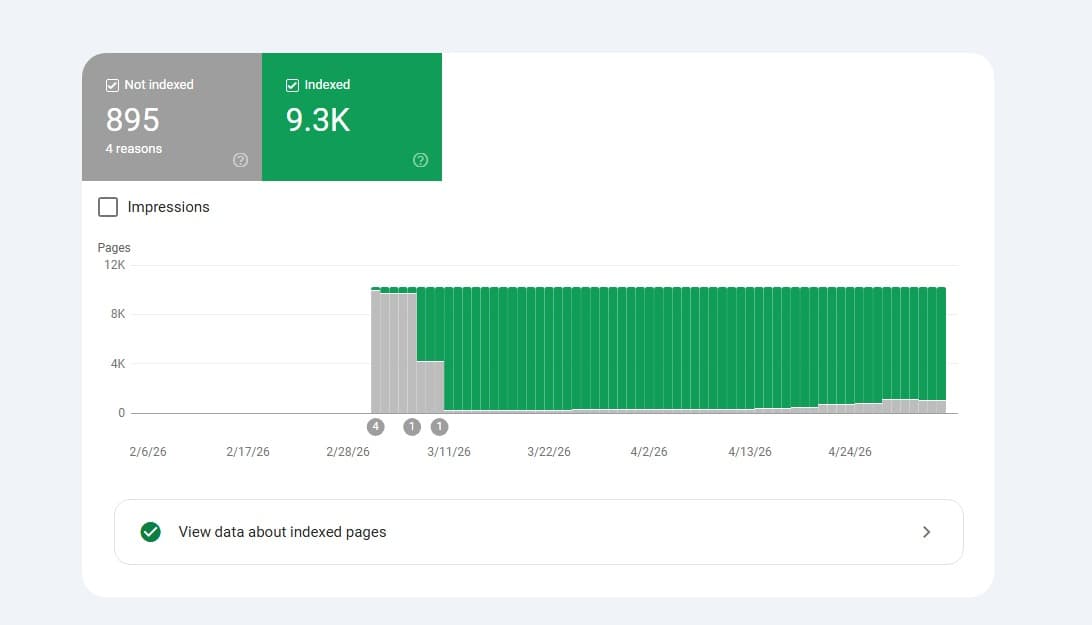
This is exactly where prompt first writing breaks. The workflow can produce a lot of pages before anyone asks whether each page deserves to exist. An evidence pack slows that down in the right place. It forces the team to ask what is unique, useful, sourced, and reviewable before turning generation into a publishing habit.
How This Fits Google's Guidance
Google's guidance points in the same direction, even if it does not use the phrase "evidence pack."
Google Search Central's guidance on generative AI content says generative AI can help with research and structure, but using AI to generate many pages without added value may violate its spam policies.
That is a useful constraint. It means the question is not "Did AI write this?" The better question is "Did the team add enough value, judgment, accuracy, and trust for this page to deserve attention?"
Evidence packs make that question operational. They give editors something to inspect. Are the sources real? Are the claims supported? Are the examples specific? Are the limits clear? Does the page help the intended reader, or is it mainly trying to occupy a query?
With it, the review becomes judgment.
When Prompt First Writing Is Still the Right Tool
I would still use prompt first writing in a few places.
Use it for early ideation when you want rough angles, not final priorities. Use it after the brief is already strong and the evidence has already been selected. Use it for rewriting, simplification, headline variations, and turning dense notes into a cleaner first pass.
Just do not confuse a smoother draft with a stronger asset.
If the team has no evidence, no audience question, no source hierarchy, and no audit standard, a better prompt will mostly make the weakness sound more polished. That may help the page pass a quick internal review. It will not make it more defensible.
Conclusion
Use prompts to accelerate expression. Use evidence packs to improve judgment.
Prompt first writing wins when the stakes are low and the thinking is already done. Evidence pack first writing wins when the article needs to be trusted, cited, or used by a real operator making a real decision.
For GEO teams, that distinction matters more every year. AI writing is cheap. Generic content is cheap. The scarce thing is not another draft. The scarce thing is a system that helps a team decide what is true enough, useful enough, and specific enough to publish.
Start there. Then let the writing tool help.

About SeanG
- Founder of Rankaris
- Former systems designer focused on AI search for over 2 years
- Independent developer writing about GEO and AI visibility
Identity: X · LinkedIn · gsc578045031@gmail.com